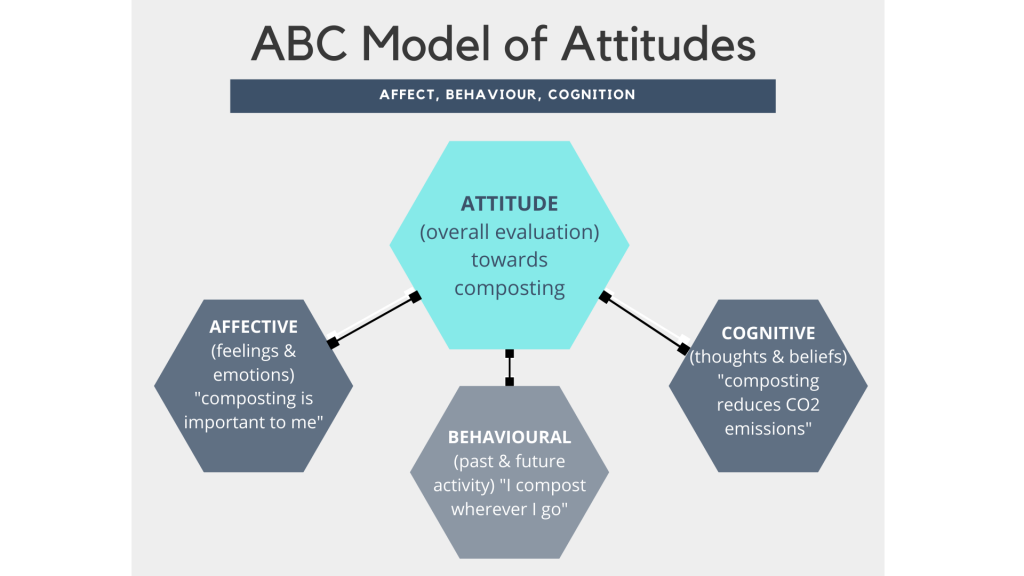
In consumer behaviour, an attitude is usually defined as a learned predisposition to respond in a consistently favourable or unfavourable way towards an object (a brand, product, service, or idea); because attitudes have a motivational pull, we often infer them from behaviour.
A useful reminder for student marketers is that attitudes are situational. You might prefer Brand A, but still buy Brand B if it is on offer, or if you are rushing; the situation can weaken the attitude to behaviour link.
One way to make sense of why attitudes exist is Katz’s functional theory. Katz argues attitudes can serve different purposes: utilitarian (reward, pain avoidance), value-expressive (identity and self-concept), ego-defensive (protecting self-esteem), and knowledge (creating order and meaning). This matters because two people can dislike the same advert for totally different reasons; changing their attitudes means targeting the right function.
When you are analysing an attitude, the ABC (tricomponent) model helps:
- Affect: feelings about the object
- Behaviour (conation): intention or tendency to act
- Cognition: beliefs, knowledge, and mental images
Finally, if the Theory of Planned Behaviour is handy: intentions are shaped by attitudes and social pressure (subjective norms), plus perceived behavioural control; whether someone thinks they can actually do the behaviour.
I really enjoyed reading this post and I think you explained attitudes in a really clear and structured way. The definition at the start set a strong foundation, and I liked how you immediately linked it to real behaviour, like switching brands when you’re in a rush. I feel the breakdown of Katz’s functional theory was especially strong because it shows that attitudes aren’t all formed for the same reason, which is something we often forget. The ABC model explanation was also concise and easy to follow. One thing I think could strengthen it slightly is adding a quick real brand example to show how a marketer might target one of the attitude functions. Overall, this was clear, well-organised, and a great summary of key attitude theories.
I really like how clean and structured this is, it feels confident and clear without overcomplicating things. The reminder that attitudes are situational is especially strong because that’s where a lot of the “why do I say one thing and do another?” tension actually sits.
What if you lean into that contradiction more, if attitudes are meant to be a “learned predisposition,” why do we constantly act against them? Price and time pressure explain some of it, but you could bring in something like cognitive dissonance, what happens after we act against our stated attitude? Do we then adjust our beliefs to make ourselves feel better?
Your use of Katz is good, but I think you could complicate it slightly as attitudes probably don’t sit neatly in one function? A sustainable brand, for example, could be utilitarian, value-expressive and ego-defensive all at once. Acknowledging that overlap would show you’re not just accepting the framework at face value and with the Theory of Planned Behaviour, you could question whether intention always leads to action, especially in emotional or impulsive contexts. We might intend to behave one way, but that doesn’t mean we will.
test
This is a clear, academically grounded overview. You define attitudes accurately, remind the reader that the attitude–behaviour link is situational, and then introduce Katz, the ABC model, and TPB in a logical sequence. The Katz section is especially useful because it explains why the same “dislike” can have different underlying functions, which is a strong insight for targeting. To strengthen it critically, I’d soften the claim that we infer attitudes from behaviour, because behaviour is often constrained by price, availability, habit, and time pressure, so it can be a weak indicator of underlying attitudes. I’d also add one concrete example that runs through all three frameworks, showing how function, affect/cognition, and perceived control jointly shape intention and action. Finally, a short limitation would add balance: TPB explains deliberate, planned behaviour better than impulsive or habitual purchases, where heuristics can override intentions.