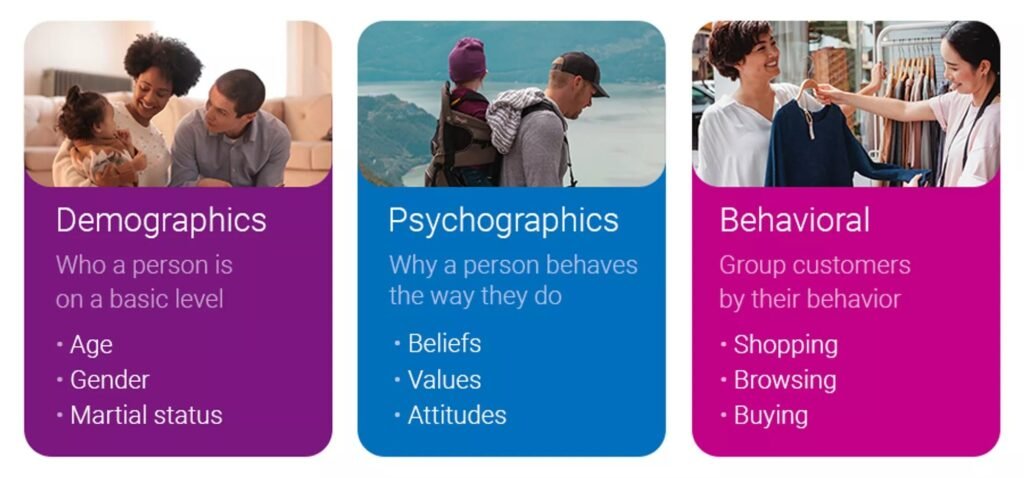
If you have ever looked at two people who seem identical on paper, same age, same income, same city, and wondered why they buy completely different things, you are already thinking in psychographics. Psychographics often gets bundled in with “lifestyle”, but it goes wider; it pulls in attitudes, interests, opinions, values, emotions, perceptions, beliefs, plus cultural and political influences. In other words, it helps explain the reasons groups make certain choices, not just the fact that they do.
That distinction matters because demographics tell us who buys, whereas psychographics gets closer to why they buy. So instead of segmenting a market as “students aged 18–24”, you might uncover mindsets like “achievement-driven”, “security-seeking”, or “experience-hungry”, and then tailor messaging to what those people actually care about.
A lot of psychographic research relies on surveys and then groups people based on patterns. One common approach uses AIOs: Activities (what people do), Interests (what they prioritise), and Opinions (what they believe). From there, brands can define target markets, challenge stereotypes about customers, position products, and even respond to social issues in a more informed way.
Motivation theory links neatly into this. Needs create tension, and people act to reduce it by pursuing goals. Some goals are broad, like “getting a degree”, while others are specific, like choosing a particular course or university. Needs can also be triggered in different ways, physiological, emotional, cognitive, or situational, which is why context and environment can change decisions fast.
There are limits though. Lifestyle segments can be too general, and it is hard to prove people behave consistently inside a segment. Meanwhile behavioural targeting (tracking online behaviour) can get ultra-personal, but raises real concerns about privacy and manipulation.
I really enjoyed reading this post and I think you explained psychographics in a really clear and mature way. The opening line about two people looking identical “on paper” was a strong hook and immediately highlighted why demographics aren’t enough. I feel the distinction between “who” and “why” was especially well put, and the mindset examples like “achievement-driven” made the concept feel practical rather than abstract. I also liked how you linked psychographics to motivation theory, as it showed deeper understanding rather than just describing segmentation. The ethical note at the end about privacy and manipulation added a strong critical perspective too. One thing I think could strengthen it slightly is adding a quick real brand example using psychographic targeting. Overall, this was thoughtful, well-structured, and showed strong analytical thinking.
I like this a lot, especially the way you clearly separate “who buys” from “why they buy.” That distinction is simple but important, and you’ve explained it in a way that makes psychographics feel practical rather than abstract. The AIO explanation works well too. It shows how psychographics is actually applied rather than just defined. Linking it to motivation theory really works as that connection makes the framework feel psychologically grounded instead of just a marketing tool.
What I found most interesting, though, is the limitation you mention at the end. That’s where I think you could go into more. People don’t behave consistently across all categories of their lives. Someone might be security-seeking with money but completely impulsive with travel. That situational shift challenges how stable psychographic segments really are. There’s also an interesting tension between survey-based psychographics and behavioural tracking. What people say they value doesn’t always match what they do online. That gap could be explored further especially when it comes to privacy and manipulation in digital targeting.
I really liked how clearly you explained the difference between demographics and psychographics, especially the “who” versus “why” distinction. That line made it click straight away. The part about uncovering mindsets like “achievement-driven” or “security-seeking” felt much more realistic than just grouping people by age.
One thing that made me think though is whether those mindsets are actually stable. Do you think people stay “experience-hungry” or “security-seeking” long term, or could they shift depending on context (like stress, finances, or life stage)? It makes me wonder how reliable psychographic segmentation really is in practice, even if it feels more insightful than demographics.