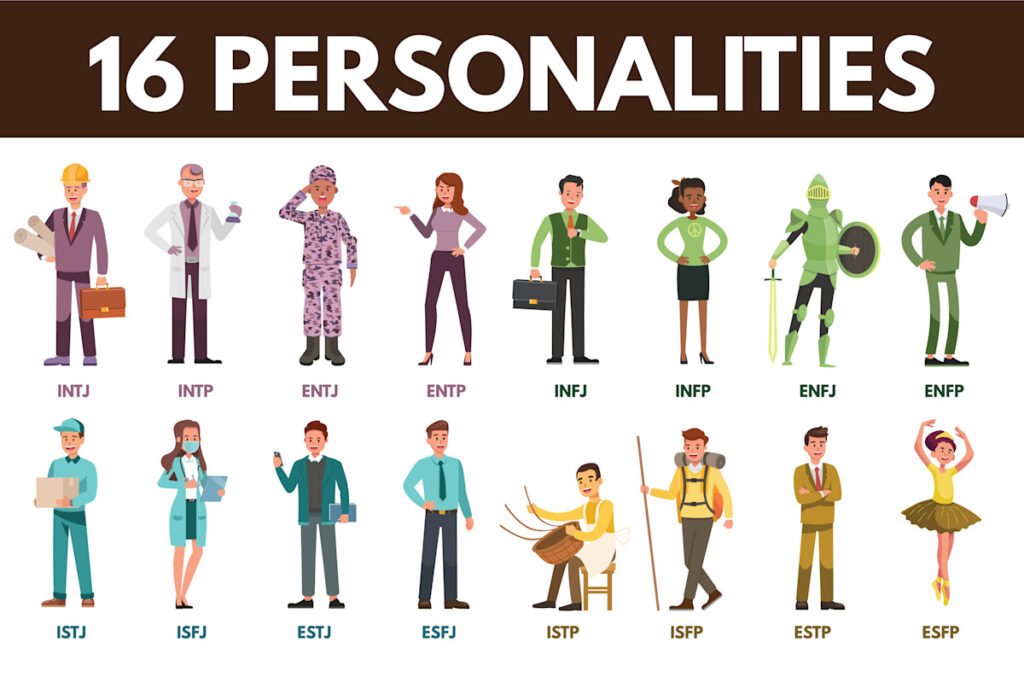
f you have ever taken a personality quiz in a seminar, group project, or careers session, chances are it was the Myers-Briggs Type Indicator (MBTI). In our topic, MBTI sits under the typology approach; it groups individuals into recognised “types”, building on Carl Jung’s ideas.
MBTI is built around four preference pairs. You are not being tested on ability; it is more about what you naturally lean towards:
- Extraversion or Introversion; where you tend to focus your energy
- Sensing or Intuition; whether you prefer concrete details or patterns and meaning
- Thinking or Feeling; whether you prioritise logic or people and context when deciding
- Judging or Perceiving; whether you prefer structure or flexibility QAL402 – Topic 04 Personality-2
For student life, MBTI is most useful as a practical Sensing, revision can work best with examples, past papers, and step-by-step notes. If you lean Intuition, you might remember more by linking themes across topics and building mind maps. If you lean Judging, deadlines and checklists can reduce stress. If you lean Perceiving, short focused sprints, variety, and earlier “rough drafts” can stop last-minute panics.
The important bit is the limitation. Research critiques argue that forcing people into neat categories can be misleading, because personality tends to sit on continua rather than strict either-or boxes; MBTI results can also shift when people retake it.
Use MBTI to start better conversations in teams and to adjust how you study; do not use it to define what you can or cannot do.
I really enjoyed reading this post and I think you explained MBTI in a really clear and practical way, especially linking it to student life rather than just theory. The examples about revision styles (Sensing vs Intuition, Judging vs Perceiving) made it feel immediately useful, not just conceptual. I feel the way you highlighted the limitations at the end was especially strong, as it shows critical thinking rather than just accepting MBTI at face value. The reminder to use it as a conversation starter rather than a label was a great takeaway. One thing I think could strengthen it slightly is adding a short link back to how this applies to consumer behaviour or marketing contexts. Overall, this was clear, balanced, and really well explained.
I like that this is clear, balanced and you’re not just blindly praising MBTI. The helpful shorthand, not your whole personality is strong and feels grounded rather than gimmicky!
You could interrogate the typology approach a bit more, you talked that personality sits on a continuum (true), but you could contrast MBTI with trait theory like the Big Five which has a stronger first hand backing? That would show you’re not just describing MBTI, but positioning it within wider personality research!
I also think there’s an interesting consumer behaviour angle you could lean into more, like marketers love typologies because they’re simple and segmentable (maybe not a word) but does that risk stereotyping? If brands start designing messages around “types” are they oversimplifying complex individuals?