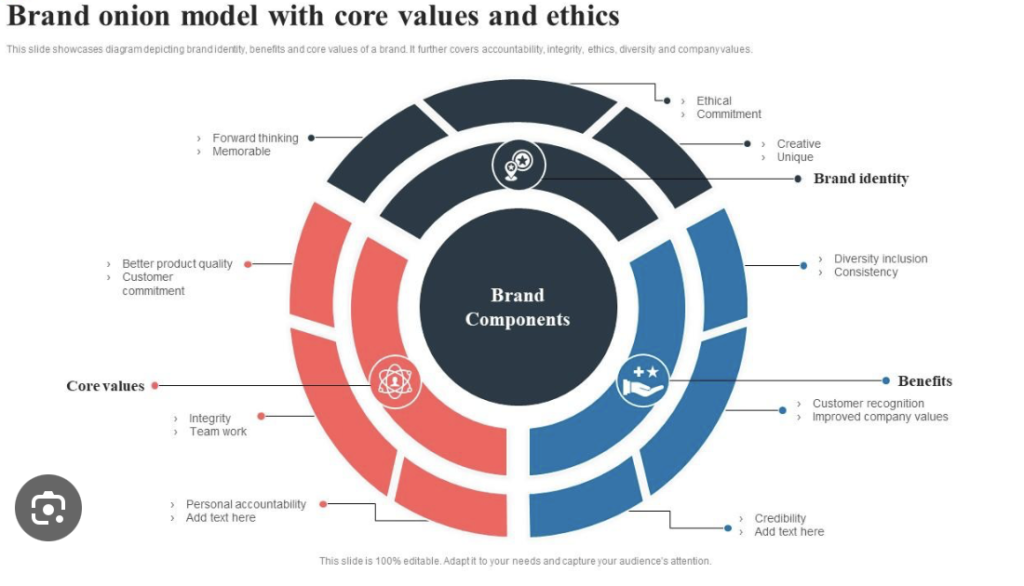
The Brand Onion is a handy way to map what a brand means to people, then connect that meaning to real buying behaviour. Think of it as layers, from what customers see on the outside, through what they feel, to what the brand stands for at its core. Done well, it explains why two products with similar features can still trigger very different choices.
Start with the outer layer, the “signals”; name, logo, tone of voice, packaging, price cues, even UX details. These cues are processed quickly and often automatically; they feed fast, intuitive judgement and help shoppers decide whether a brand is “for me” before they compare specs. This lines up with the idea that much decision-making happens through fast, low-effort thinking.
Move inward to functional and emotional benefits; what problems the brand solves, and how it makes people feel. Here you find the risk-reduction effect of branding; familiarity and trust can make a purchase feel safer, especially when the customer cannot fully evaluate quality upfront.
Next come personality and values; the human traits and principles people attach to the brand. These shape attitudes, loyalty, and word of mouth, because they give customers a story to repeat and a stance to share. At the centre is the brand essence or purpose; the shortest, clearest statement of what the brand is really about. Brand onion style models are often used to align teams around that core so that every touchpoint reinforces it.
Finally, link the onion to identity; people use brands to signal belonging and express who they are, not just what they need. If your inner layers are clear, your outer signals become more consistent, and consumers make the “right” choice faster, then feel better about it afterwards. That is the onion in action; simple, practical, behavioural.
I really enjoyed reading this post and I think you explained the Brand Onion in a really clear and practical way. I liked how you walked through each layer step by step, as it made the model easy to understand rather than just theoretical. I feel the way you linked the outer “signals” to fast, intuitive decision-making worked especially well and clearly connected branding to real buying behaviour. The point about brands reducing perceived risk also stood out, as it explains why people often choose familiar brands even when products are similar. One thing I think could strengthen it even more is adding a quick brand example to show the onion in action. Overall, this was well-structured, easy to follow, and a really strong explanation of how branding influences consumer choices.
This post does a great job of breaking down the metaphor of the “brand onion” and connecting it to consumer behaviour in an accessible way. The writing is clear, and you’ve made complex ideas feel tangible, which is helpful for readers from different backgrounds.
One area that could be improved is linking the discussion more directly to established consumer behaviour theory. Adding a couple of concise references or frameworks (for example on brand perception or decision-making) would strengthen the academic foundation of the post while still keeping the engaging tone.